

UNITED NATIONS (AP) — A strengthening El Nino has already broken records for intensity at its early stages, and it likely will spark even more wild weather worldwide as it grows, “adding fuel to a planet already on fire,” United Nations officials warned Friday.
A key area of the Pacific Ocean used to measure the strength of El Nino this week reached its warmest and most intense level ever recorded for the 15th week since it formed, which is early in its lifetime, scientists at Columbia University reported.

El Nino — a natural warming of the Pacific near the equator that warps weather patterns worldwide — won’t peak for several months and should last through spring 2027. The World Meteorological Organization, a U.N. agency, cautioned on Friday that it will likely trigger extreme heat, drought and rainfall well into next year.
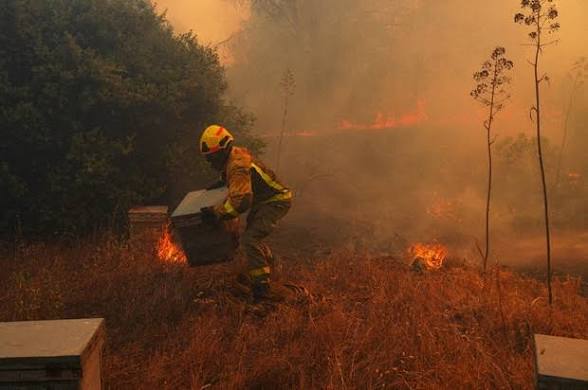
“Two months ago, I warned that El Nino was arriving on our doorstep. Now it is inside the house — and turning up the heat,” United Nations Secretary-General Antonio Guterres told reporters Friday. “We have already endured a summer of extremes — record-shattering heat domes; apocalyptic wildfires raging in Spain, France and far beyond; thousands of lives lost in the scorching conditions.”
“But according to the latest science, this is only a warm-up act,” Guterres said, saying as the El Nino strengthens it will be “adding fuel to a planet already on fire.”
“We are in uncharted territory,” he said. “The climate crisis is in overdrive.”
Most computer forecast models are showing that this El Nino will likely break the all-time record for intensity when it peaks, sometime late fall or so, but that’s not guaranteed, scientists said.
Spain also had the added problem of land abandonment, which left unmanaged plants and trees to dry out, Otto said. France’s Bordeaux region, meanwhile, had thick groves of pines that also burn well when a fire starts, she said.
World Weather Attribution — an international collaboration of scientists who examine extreme events to determine climate change’s role, if any — did that study so quickly, the report didn’t get peer reviewed, which is the scientific gold standard. But Otto and her colleagues used techniques that are scientifically accepted, and many of their reports are published in peer-reviewed journals later.
Warming world means fires ignite ‘more explosively’
Otto’s team calculated how much climate change — from the burning of coal, oil and gas — increased the chances for fires of this intensity to happen. They did so by comparing fire weather severity levels to past measurements for the region and to what they would be if the world was 2.5 degrees (1.4 degrees Celsius) cooler. That is how much Earth has warmed since pre-industrial times.
“This study makes sense and provides numbers to confirm what fire scientists already knew,” said Syracuse University fire scientist Jacob Bendix, who wasn’t part of either research. “We have always known that fires ignite more easily and spread more explosively under conditions of extreme heat and drought. And we’ve known for decades that extreme heat and drought are becoming more common due to anthropogenic climate change. So the general outline of these events, if not all the details, was tragically predictable.”
Thursday’s other study, in the journal Scientific Reports, finds that there were about 10 extreme fire weather days a year in Southern Europe in earlier decades, but it is now up to around 25 a year, said study author Raúl Cordero, a climate scientist at the University of Groningen in the Netherlands. And it is not just more frequent bad fire weather days. Those days are about 50% more intense than they were from 1981 to 2010, his study said.
Fires were decreasing until climate change overwhelmed gains
The number of Southern European fires and amount of land burned had decreased quite a bit from the 1980s to 2018, mostly because of better fire suppression and management techniques, Cordero said. But then things quickly got worse fast because climate change overwhelmed that improvement, he said.
“It doesn’t matter how many resources or how much money you have, you just cannot stop the propagation of a fire when the weather is so extreme,” Cordero said. “The climate forcing is so extreme nowadays that it’s just amazing.”
University of California Merced fire scientist John Abatzaglou, who also wasn’t part of either research, said, “these findings make clear that climate change is not just a future problem, it’s already here.”
“We need to stop burning fossil fuels,” Otto said. “Because as long as we keep burning fossil fuels, temperatures will increase globally. And that will mean that these fire weather conditions will get worse and worse and worse. And there are hard limits to what we can adapt to.”
___
The Associated Press’ climate and environmental coverage receives financial support from multiple private foundations. AP is solely responsible for all content. Find AP’s standards for working with philanthropies, a list of supporters and funded coverage areas at AP.org.