

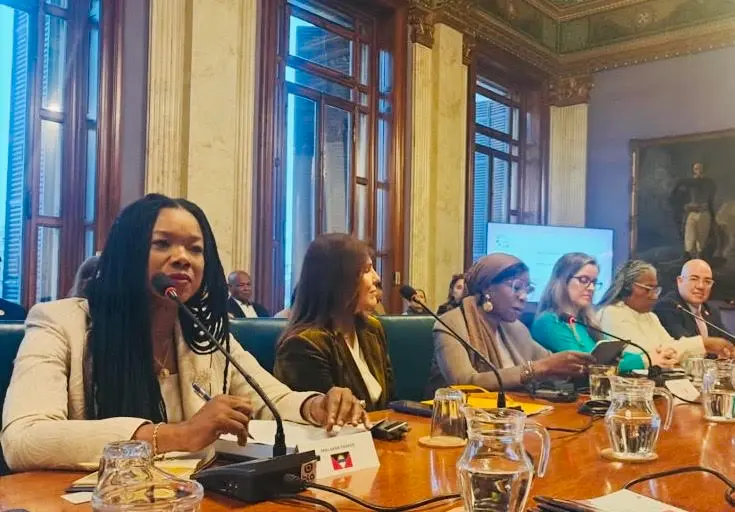
Antigua and Barbuda opposition Senator Malaka Parker has called for governments and opposition parties across Latin America and the Caribbean to establish lasting bipartisan mechanisms to advance the Montevideo Consensus on Population and Development. Senator Parker made the call today while serving as a panellist at the Parliamentary Forum on Advancing the Montevideo Consensus, held at the Parliament of Uruguay. The Forum was convened by the United Nations Population Fund (UNFPA), the Global Parliamentary Alliance for Health, Rights and Development and the European Parliamentary Forum for Sexual and Reproductive Rights.
The event preceded the Sixth Session of the Regional Conference on Population and Development in Latin America and the Caribbean which continues until August 20th, 2026. Senator Parker presented as a panelist in the second session, “The Role of Parliamentarians in Advancing ICPD Values,” addressing the question of “Bridging the Political Divide and Building Cross-Party Alliances.”

Drawing upon her experience as a parliamentarian, trade-union leader, and regional development advocate, Senator Parker argued that population and development policies must not be allowed to rise and fall with electoral cycles. “The Montevideo Consensus cannot become another document that governments endorse internationally but fail to implement at home. We must not merely agree with its principles; we must prioritise them, finance them and translate them into laws, programmes and measurable outcomes.” She stressed that sexual and reproductive health and rights, violence against women and girls, youth development, population ageing and social inequality should never be treated solely as government or opposition issues. “A woman’s safety, a young person’s future, an elderly citizen’s dignity and an individual’s right to bodily autonomy do not change according to which political party holds office. These are national obligations requiring continuity and collective ownership.”
Senator Parker recommended permanent parliamentary committees on population and development, with meaningful participation by both government and opposition members. These committees should scrutinise budgets, monitor implementation, receive reliable demographic data and engage civil society and affected communities. She also urged governments to provide opposition parliamentarians with genuine opportunities to participate in key national agendas. At the same time, she said opposition members must recognise that constructive engagement forms part of their accountability function. “Bipartisanship does not mean abandoning scrutiny or silencing disagreement. It means finding the courage to work across the political divide where the rights, dignity and welfare of our people demand it.” Senator Parker called upon UNFPA and other development partners to include opposition parliamentarians in consultations, technical meetings and capacity-building initiatives. She further encouraged civil-society organisations advancing rights-based issues to engage all political parties and to ensure that essential human-development issues are not reduced to partisan contests.
Her proposed measures included dedicated budgetary support for reproductive health and social protection; stronger data collection; laws protecting women, children and vulnerable groups; greater youth participation; and clear accountability mechanisms for monitoring national implementation. “Consensus without implementation is simply another promise. Genuine bipartisan action requires shared institutional mechanisms, protected funding, transparent monitoring and policies capable of surviving a change of government. These must be advanced in the context of real data.“