

San José, 22 July 2026 (IICA). The countries of the Americas expressed strong support for the work plan drawn up by the Inter-American Institute for Cooperation on Agriculture (IICA), which will run through 2030 and is designed to strengthen the continent’s agrifood systems so they contribute to economic prosperity, poverty reduction, food security, environmental sustainability and resilience, and decent work.
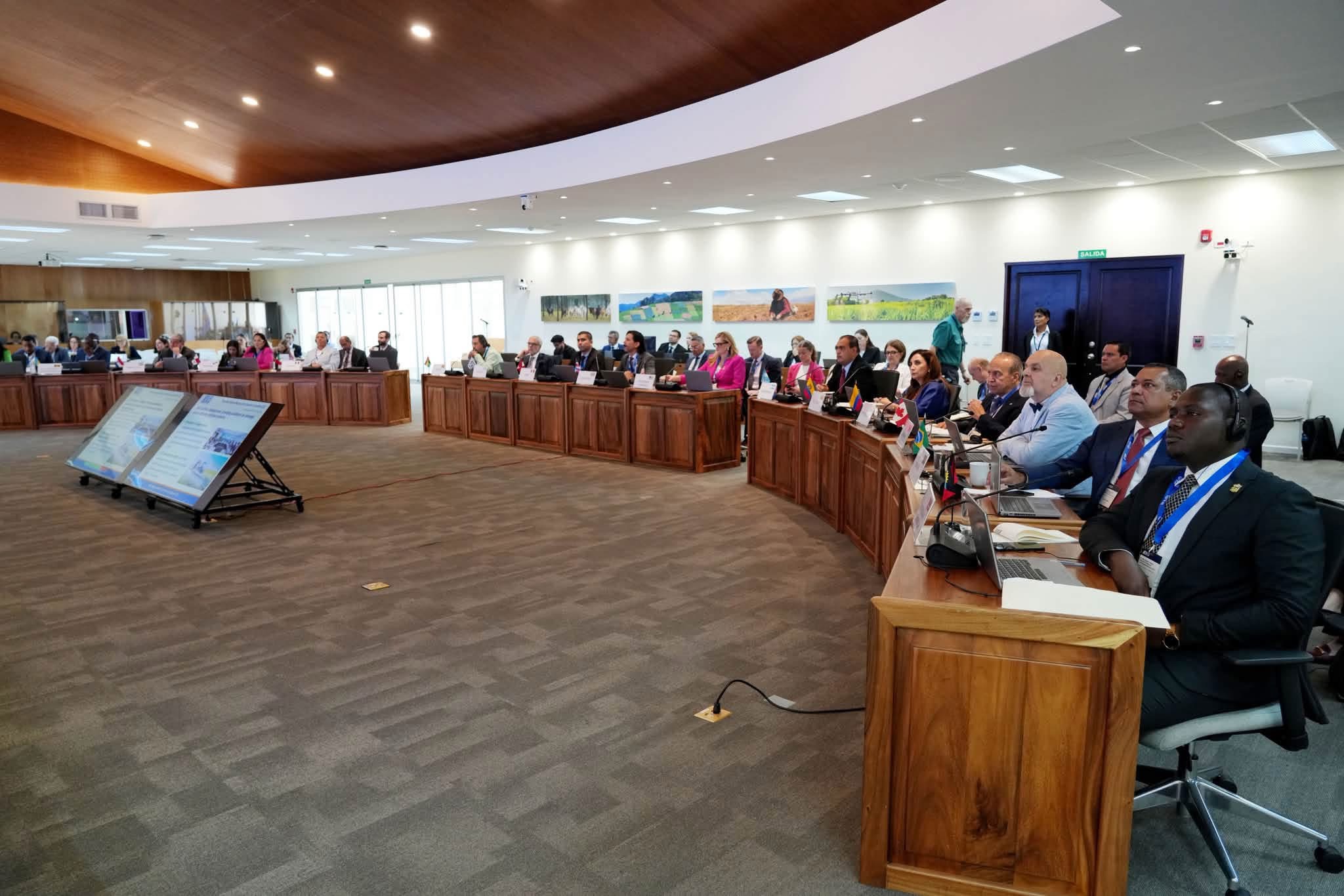
The plan was presented during the annual meeting of IICA’s Executive Committee, one of the organization’s governing bodies, held in San José, Costa Rica, which brings together ministers of agriculture and other senior agricultural officials from the Americas. Representatives of other international organizations, delegates from observer countries, members of the diplomatic corps in Costa Rica, and special guests also take part.

During the opening session of the meeting, IICA Director General Muhammad Ibrahim gave an overview of the work carried out in his first six months in office, and formally presented the 2026-2030 Medium-Term Plan (MTP) to the ministers, which was prepared working closely with the countries and includes their needs and requirements.
Following the presentation, the representatives of the Member States were agreed that the organization’s roadmap addresses the main challenges facing the region’s production systems, and pledged to work together to achieve measurable concrete results.
Roberto Linares, Minister of Agricultural Development of Panama, was elected as Chair of the Executive Committee and referred to the importance of IICA’s work for the benefit of agriculture in the Americas: “The fact that food security and sustainable development are currently strategically important issues on global agendas underscores the relevance of international cooperation even more. Therefore, this meeting represents an excellent opportunity to continue along the path of multilateral collaboration for the benefit of our countries’ agricultural and rural sectors.”
Ibrahim emphasized that during the first half of the year, the time it took to discuss and design the MTP, IICA continued to lead dialogues and provide solutions to the complex situations affecting the countries’ agricultural sectors, such as fertilizer shortages and rising input and energy costs.
The four technical cooperation programs that are to be implemented are set out in IICA’s MTP:
• Science, technology, and innovation for production development;
• International trade, regional integration, and agribusiness;
• Agricultural health, biosecurity, and food safety and quality;
• Strategic natural resources for agrifood system productivity and resilience.
“The plan is ambitious at a time of great challenges, and is tailored to the countries’ requirements,” Ibrahim said.
The IICA Director General explained that the work of the four programs will be coordinated to strengthen the hemisphere’s agrifood systems and promote their economic, environmental, and social sustainability. The latter includes the development of incentives to empower women and youth in agriculture, and to mitigate migration from rural areas to cities.
“We are going to work together to make agriculture an engine of development and thus attract the new generation of farmers we need in the Americas,” he explained.
In this regard, he stressed that one of the MTP’s distinctive elements was that it called for the provision of technical cooperation adapted to the heterogeneous nature of the production systems of IICA member countries, in terms of both scale and production models and the use of science and technology.
Focus on science and technology
Michelle Bekkering, Deputy Under Secretary for Trade and Foreign Agricultural Affairs at the U.S. Department of Agriculture (USDA), said that her country appreciated IICA’s work plan, particularly with regard to its focus on the incorporation of science, technology, and innovation, and its emphasis on building smoother international trade in food, and on biosecurity issues. “This ambitious plan is going to be very successful,” she suggested.
Cleber Soares, Deputy Minister of Agriculture and Livestock of Brazil, the country that currently holds the chair of the Inter-American Board of Agriculture (IABA), IICA’s highest governing body, said that in recent months he had visited several countries in the continent to discuss the guidelines of the MTP. “The countries shared their concerns and expressed their full support. This IICA roadmap includes modern, necessary issues, such as the incentive to work for the production of fertilizers, since today we depend to a large extent on imports and the world has put us in a very severe crisis,” he observed.
Anthony Smith, Minister of Agriculture, Land, Fisheries, and Blue Economy of Antigua and Barbuda, pointed out that: “As a small, developing island state, we have vulnerabilities and we particularly appreciate IICA’s work in support of resilience and food security. The plan is aligned perfectly with our needs.”
“We support the IICA Director General’s vision, which is consistent with our own vision of agriculture, with emphasis on productivity and food health, quality, and safety. We also agree on the need to adapt cooperation to the new production models and new consumption trends,” commented Raquel Solís, Ecuador’s Deputy Minister of Agricultural Productive Development.
On behalf of the Government of Honduras, the Undersecretary of Agriculture, José Francisco Ordóñez, also endorsed IICA’s MTP: “It contains the issues that we consider to be the main ones, and we are pleased to see that the issues of family farming are included. In Honduras, we feel the need to teach our small producers to adapt to climatic difficulties, for example, by harvesting and managing water.”
Agustín Tejeda, Undersecretary of Agriculture, Livestock and Fisheries of Argentina, affirmed that his country’s priorities were aligned with IICA’s MTP and gave it his full support. “IICA,” he emphasized, “is key to defending conditions of transparent market access for our agricultural products in international forums. We value IICA’s work based on scientific evidence and technical excellence, which is necessary to deepen hemispheric cooperation and consolidate agriculture in the Americas as an engine of growth, inclusion, and development.”
Tejeda underscored the Institute’s role as a bridge between nations and regions within and beyond the hemisphere: “IICA also has a very important role to play in representing the continent’s voice in the world and in relations with other regions. The experience of the Africa-Americas Ministerial Summit focused on productivity and agrifood systems, organized in San José in 2022, was very positive, and a closer relationship should be developed.”
On that point, the Argentine delegate proposed to the Executive Committee that a second summit be held in October 2026 in Buenos Aires.
On behalf of the Government of Mexico, Víctor Manuel Vanegas Tapia, Head of his country’s Office of the Secretariat of Agriculture and Rural Development, recognized “IICA’s efforts to formulate a comprehensive and robust plan aimed at addressing the main challenges. Only cooperation enables us to develop common solutions to our problems.”
About IICA
IICA is the specialized agency for agriculture in the Inter-American system, with a mission to encourage, promote and support its 34 Member States in their efforts to achieve agricultural development and rural well-being through international technical cooperation of excellence.