

San José, 23 July 2026 (IICA) – The countries of the Americas—with the support of the Inter-American Institute for Cooperation on Agriculture (IICA)—will work to enhance their capacities to anticipate, prepare for and coordinate regional efforts to address the potential impact of the El Niño phenomenon on agricultural production and agrifood systems in the region.
Given that each country will lead and implement its own preparedness and response policies, plans, and mechanisms, IICA will coordinate with each Member State to lend support in accordance with national priorities.

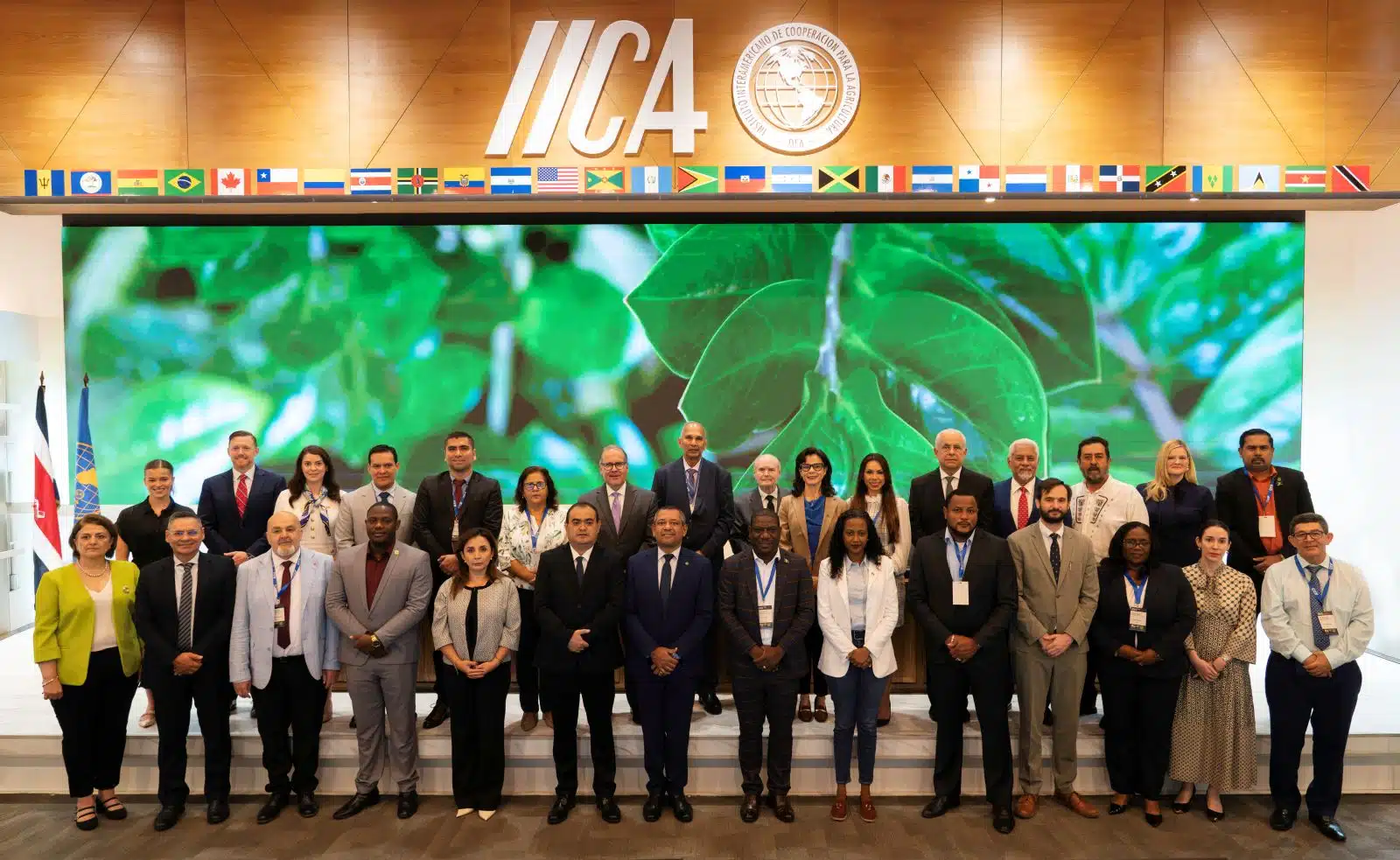
In the IICA Executive Committee meeting, held in San José, agricultural ministers, deputy ministers, and senior authorities shared experiences, outlined national priorities, and identified opportunities for regional cooperation to boost the climate resilience of the agriculture sector.
The authorities approved a resolution that tasked IICA with undertaking a coordinated response in each country, which would include updating and executing action plans; sharing information on successful experiences; improving awareness at the regional level regarding scenarios, risks, demands, and available capacities; and promoting South-South cooperation and knowledge exchange.
The resolution also extended an invitation to other international organizations, as well as to cooperation agencies, financial institutions, the private sector, academia, and other partners to coordinate efforts and to contribute technical and financial capacities.
Curt Delice, Director of Operations and Regional Integration, at IICA, explained that, “The response to El Niño must precede the emergency, transforming information and alerts into decisions, investments, and actions to protect production, income, and livelihoods. Acting on time will reduce losses and costs. To achieve this at the requisite scale, we must combine science, technology, innovation, risks management, social protection, and financing. No one country can do this single-handedly. We need a common roadmap, broader alliances, and sufficient resources to meet the challenge.”
IICA informed the ministers and other authorities participating in the Executive Committee meeting that in recent weeks, the Institute’s delegations in each country in the hemisphere had intensified discussions with agriculture sector stakeholders to determine their priorities, actions that are already being undertaken, and the areas that require support.
Stemming from these discussions, almost 30% of the countries had already identified needs and made concrete requests for technical cooperation associated with El Niño; and it is estimated that during the next six months additional demands could arise in approximately 80% of the countries.
The priorities are concentrated in three areas: risk monitoring and management; production adaptation and recovery; and water resource management and resilience.
The first area of focus is linked to early alerts, information systems, agroclimatic monitoring, impact evaluation, and integrated risk management. The second comprises all issues related to climate-smart and regenerative agriculture, the recovery of livelihoods, sustainable soil management and nature-based solutions. The third area relates to efficient irrigation, water harvesting, watershed management and infrastructure, and water security.
According to Hugo Chavarría, Manager of IICA’s Innovation and Bioeconomy Program, “The information that the countries are sharing with us will allow us to move beyond a general understanding of the risk, enabling us to develop a concrete cooperation agenda. The challenge now is to transform these priorities into proactive actions, by pooling already existing capacities and mobilizing the necessary partnerships and resources to protect agricultural production, income, and rural livelihoods.”
Different risks, urgent cooperation demands
The technical overview presented in the Executive Committee meeting stressed that the impact of El Niño will vary throughout the Americas, producing a differentiated effect on the various regions, rural areas, and production systems. While some places may experience droughts, water shortages, and higher than average temperatures, others may endure intense rainfall, flooding, and landslides.
In western and southwestern United States, northern Mexico, the Central American Dry Corridor, the eastern Caribbean, and parts of the Andean highlands and northeastern Brazil, the scenarios analyzed point to a greater risk of heat, irregular rainfall, and water shortages. These conditions could affect the availability of water for irrigation, livestock farming, rainfed crops, and small-scale farmers in particular.
In other areas of the Andean region and the Southern Cone, above-normal rainfall could occur, creating a greater risk of flooding, landslides, and damage to crops, infrastructure, and production chains.
“The impacts of El Niño will vary by country, territory, production chain, and type of producer. Some places will experience droughts, water shortages, and rising temperatures, while others may face heavy rainfall, floods, or landslides. However, the most severe effects will be felt wherever high vulnerability coincides with low anticipation, response, and recovery capacities, especially among small-scale farmers and in the most vulnerable rural areas,” explained Chavarría.
Coordinated actions in each country
“We agree with IICA’s proposed approach in relation to early warning systems, anticipating events, working together to combine capacities and respond adequately to climate phenomena,” remarked Julio Duarte Van Humbeck, Ambassador of Paraguay to Costa Rica, who shared the progress his country has achieved with respect to agrometeorological information systems, agricultural water balance, the modernization of weather stations, interinstitutional coordination, and risk management.
Fernando Vargas, Deputy Minister of Agriculture and Livestock of Costa Rica, emphasized the importance of guaranteeing food security, the availability of staple grains, cooperation between countries, financial mechanisms, and crop insurance, which he considered could be strengthened by means of a regional partnership.
“In each of our countries, we are taking the steps we believe are most appropriate to mitigate impacts and ensure the availability of food, in order to guarantee food security. Some of our countries will not be able to plant certain crops during the usual planting seasons due to the effects of El Niño, which would increase losses. Therefore, the issue of staple grains becomes all the more relevant, and that is where cooperation between countries will be key, as it will allow for trading products under clear and accessible rules,” he explained.
Cleber Soares, Deputy Minister of Agriculture and Livestock of Brazil, noted, “This issue is of the utmost relevance for everyone. Two months ago, MAPA and the National Institute of Meteorology collaborated with the World Meteorological Organization to develop El Niño forecasts for Latin America and the Caribbean. I would therefore like to make their capacities available to countries that require information not only on potential scenarios associated with this phenomenon but, above all, on climate risks.”
The region is not starting from scratch. The countries, IICA, and their partners already possess projects, experiences, technologies, and capacities that provide a solid foundation for addressing the risks associated with El Niño. As part of these efforts, the Institute conducted an internal process to identify initiatives and projects currently underway in collaboration with the countries, and identified a total of eighty-eight initiatives related to climate resilience, risk management, and agricultural adaptation, of which twenty-five directly contribute to enhancing preparedness, improving productive adaptation, protecting livelihoods, and recovering from the impacts of El Niño.
Building on this foundation, IICA has proposed moving forward with a roadmap that would facilitate the transition from preparedness to action. The first step is to prepare before impacts occur, using scientific evidence, risk analysis, climate information, and early-warning systems to guide timely decision-making. The second step is to strengthen existing capacities and initiatives and better align them with the priorities of countries, rural areas, and production sectors.
The roadmap also calls for identifying and scaling up technologies, methodologies, and solutions that have already yielded positive results, adapting them to the conditions of other countries and territories. Lastly, it proposes forging a broader partnership between governments, technical agencies, financial institutions, research centers, the private sector, and producer organizations, with the aim of pooling capabilities, expanding technical cooperation, and mobilizing the resources needed to address the magnitude of the challenge.