

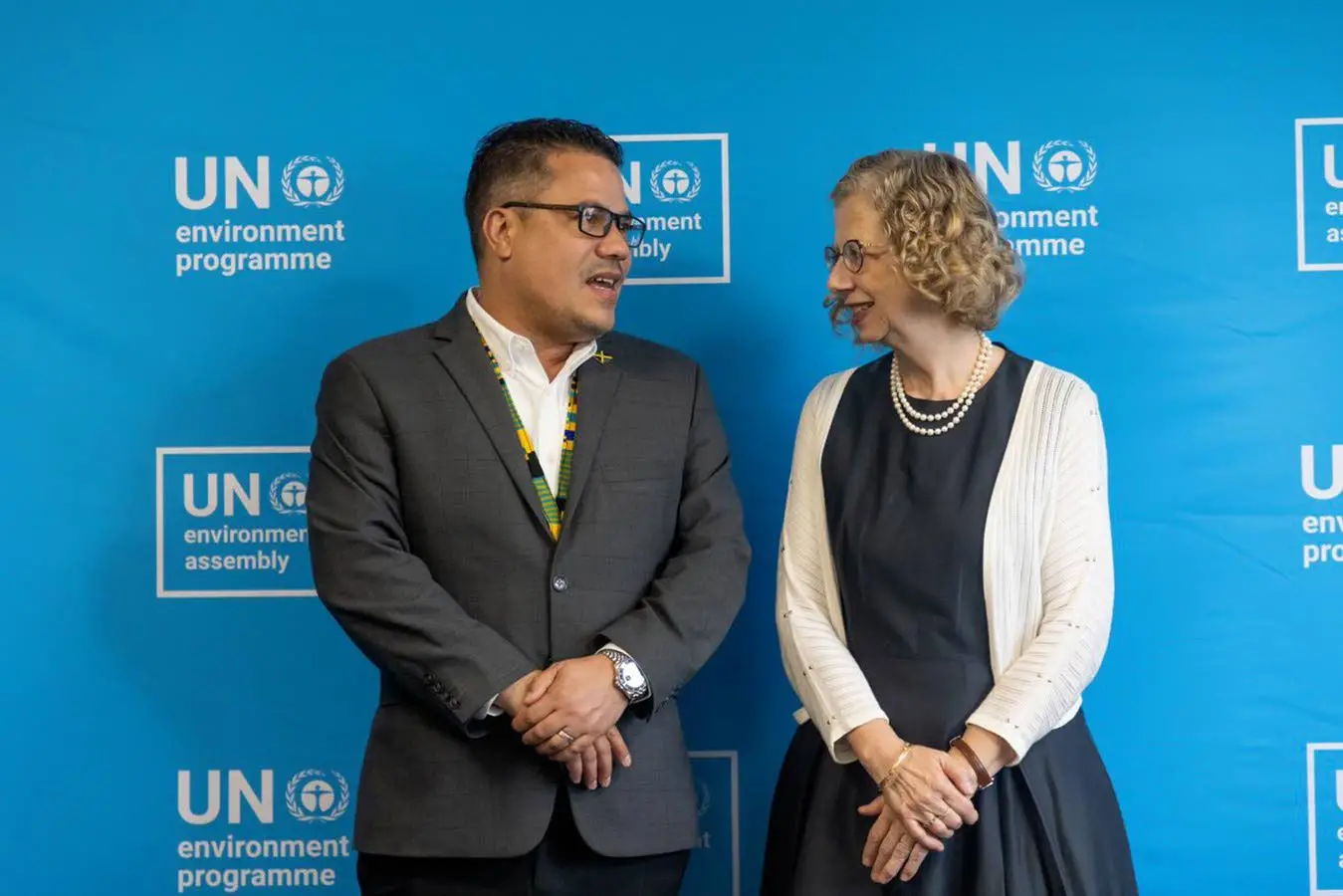
JAMAICA’S Minister of Water, Environment, and Climate Change Matthew Samuda seems set to be named the new president of the 170-country- strong United Nations Environment Assembly (UNEA).
Samuda — who is now leading the Jamaican delegation to the seventh session of the UNEA (UNEA-7) in Nairobi, Kenya — is poised to replace Abdullah Bin Ali Al-Amri, president of the Environment Authority of Oman, whose term has expired.

Late Thursday Vincent Sweeney, head of the Caribbean Sub-Regional Office for the United Nations Environment Programme, told the Jamaica Observer that the Latin American and Caribbean Group (GRULAC) is backing Samuda for the post.
The UNEA assembly is the world’s top decision-making body on the environment and this year’s session comes at what experts call a critical time for the Earth with the three planetary environmental crises of climate change; nature, land and biodiversity loss; and pollution and waste pushing natural systems to their breaking point, with potentially dire consequences for humanity.
“Time is not our friend. The matters before this assembly are of incredible importance to Jamaica, and indeed all SIDS (small island developing states). Over the last four years Jamaica has experienced all aspects of the triple planetary crisis with extreme impact,” said Samuda.
“This would be bad enough if it was an isolated incident, but over the last four years Jamaica has experienced two tropical storms — Category 4 Hurricane Beryl, and now Melissa. In that period we have also experienced our hottest and wettest day on record, and our worst, third-, and fourth-worst droughts on record. All of this has led to deteriorating soil quality, reduced pollination rates, and salt water intrusion in our water sources,” added Samuda.
He told the assembly that Jamaica will recover, and at the same time increase its resilience to external shocks and existential threats.
“We are honouring our commitments globally, while increasing environmental protection, and climate resilience locally,” declared Samuda.
He argued that the multi-dimensional vulnerability index — a new UN-backed tool to assess countries’ structural weaknesses beyond income while capturing economic, environmental, and social risks to guide equitable development aid, especially for SIDS and developing nations — is critical for Jamaica.
“UNEA-7 therefore presents another opportunity for us to demonstrate collective will in identifying and promoting sustainable and innovative solutions that will result in a resilient planet for all. This task is not the remit of any one country or group of countries, but that of all. Hence, the decisions that we take at UNEA-7 must be inclusive and cover the gamut of climate and environmental issues,” added Samuda.
He pointed out that Jamaica supports the resolutions strengthening the role of the United Nations Environment Programme (UNEP); strengthening global response on the massive influx of sargassum seaweed blooms; and accelerating global action to promote climate resilience of coral reefs.
“Jamaica remains committed to working with UNEP and other global partners in promoting a low carbon and environmentally sustainable future. Jamaica is innovative and solutions-oriented, hence we will continue to make our contribution in this regard towards a resilient planet for all,” declared Samuda.