

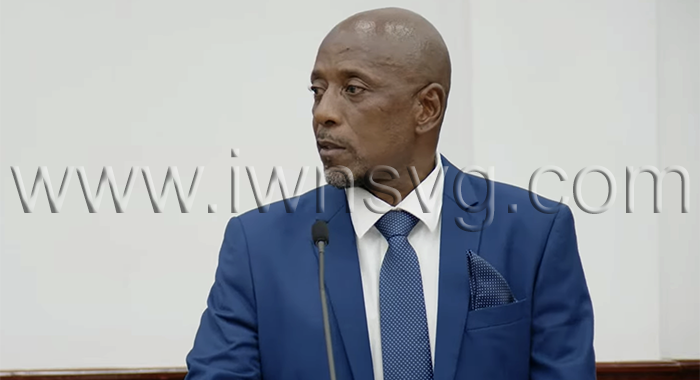
Minister of Foreign Affairs Fitz Bramble has rejected the assertion by Opposition Leader Ralph Gonsalves that Vincentian diplomats and diplomatic missions will be used as “as roving passport sales persons” under the New Democratic Party’s (NDP) administration.
Gonsalves made the assertion on Tuesday as he responded to the EC$1.9 billion budget that Prime Minister and Minister of Finance Godwin Friday presented to lawmakers on Monday.

The fiscal package includes the government’s policy on the introduction of the citizenship-by-investment (CBI) programme, which was among its campaign promises that the NDP made ahead of the Nov. 27 general election.
The party won those polls, taking 14 of the 15 parliamentary seats, with Gonsalves, who was prime minister from March 2001 to when he was voted out of office, as the sole member of his Unity Labour Party to survive the “yellow washing”.
Gonsalves quoted the section of the prime minister’s budget speech where he outlined the new government’s foreign policy and trade and investment outlook.
“The 2026 Budget marks a strategic repositioning of our foreign policy. We are moving away from a traditionally representational portfolio toward a platform for economic statecraft — the deliberate use of our diplomacy and trade policy to advance growth, investment, and fiscal resilience,” the prime minister said.
“Today, this ministry is framed not merely as a diplomatic function, but as a driver of three core components of our growth: Consumption, Investment, and Net Trade,” the eprime minister said.
“Our agenda emphasises commercial diplomacy, investment facilitation, and risk containment, ensuring that every external relationship translates into a tangible economic outcome,” he told Parliament.
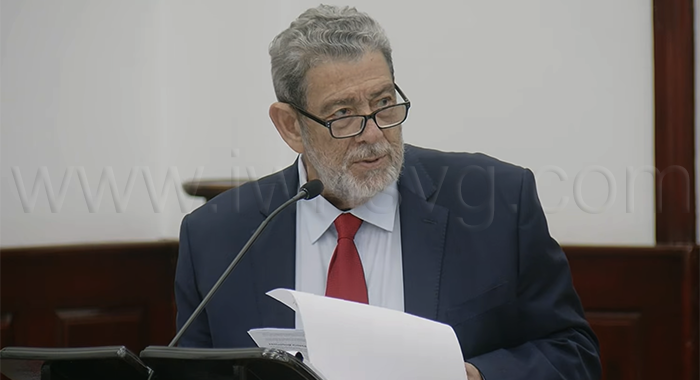
“My translation of that sentence is that the government is going to use our embassies, consulates and diplomatic representatives as roving passport sales persons,” Gonsalves said as he led off the debate on the budget.
“All the talk on the section of commercial diplomacy, economic diplomacy and investment facilitation means one thing: selling passports. But they don’t have the courage to say that. Remember that,” said Gonsalves, aged 79, adding that he has been in active politics for 58 years.
‘After that comment this morning…’
Bramble, who was not present in Parliament when Gonsalves made the comment, responded to the opposition leader as he made his contribution to the debate later on Tuesday.
“I listened quite attentively to the leader of the opposition. I promised myself not to talk about his performance this morning, or maybe lack thereof,” the foreign minister, an economist and former diplomat, told lawmakers.
“But I want to say one thing, and this is it: I was extremely disappointed that the longest-serving prime minister or the longest served prime minister in this country expressed what he expressed this morning,” Bramble said of Gonsalves, who was prime minister for four months short of 25 years.
Bramble quoted Gonsalves’ comment that the government was going to use the nation’s diplomats as roving passport salespeople.
“… it is no secret that I have respect for the former prime minister, the leader of the opposition, but I will say this: after that comment this morning, after that comment this morning, after that comment this morning, I would leave that right there.”
SVG entering CBI space ‘at a pivotal moment’
In his budget address, the prime minister said securing a resilient, sustainable, and sovereign financial future for SVG is of critical national importance.
“The economic vulnerabilities inherent to our status as a small island developing state –particularly the high and recurring costs of climate resilience, coupled with the fiscal risks of relying solely on traditional debt — demand a strategic and non‑traditional approach to capital mobilisation,” Friday told Parliament.
He said it was in that context that he was announcing the government’s “firm intention” to launch a CBI programme by the middle of 2026.
“Let me be clear from the outset: this will not be a revenue‑at‑all‑costs programme. It will be a sovereign capital mobilisation strategy, designed to strengthen national resilience, reduce debt dependence, and finance long‑term development—and it will be built on a foundation of uncompromising integrity,” the prime minister said.
SVG is the only one of the five independent Organisation of Eastern Caribbean States without a CBI programme, the ULP having ended after winning the 2001 election, the programme that the previous NDP administration had operated.
Friday said SVG was entering the CBI space “at a pivotal moment.
“We will therefore adopt the most stringent regional and international standards from the very first day of operation,” he said.
SVG’s CBI ‘will not trade reputation for short‑term gain’
He said SVG’s CBI programme will be positioned deliberately as secure and reputable, and fully aligned with emerging international norms.
“It will adhere to the mandated investment floor, residency requirements, incorporate best‑in‑class due diligence systems, and include continuous due diligence throughout the life of citizenship; robust, multi‑layered background screening; and
a residency requirement.
“We will not compete on volume. We will not compromise on standards. And we will not trade reputation for short‑term gain,” the prime minister told lawmakers.
He said the governance of revenue generated by CBI is equally important, adding, “All proceeds from the programme will be channelled through a legislatively established and ring‑fenced vehicle: the St. Vincent and the Grenadines Investment Fund (SVGIF).
“This fund will ensure that 100% of non‑debt capital mobilised is directed exclusively to verifiable, long‑term productive expenditure — not recurrent spending, and not political discretion.”
He said that to safeguard this principle, the government will enshrine in law a strict fiscal resilience and expenditure protocol.
Under this legally binding framework, resources will be dedicated to productive capital investment, including climate‑resilient infrastructure, the financing of public investment and productive sectors and reducing long‑term costs and strengthening competitiveness.
The prime minister said CBI revenue will also fund social infrastructure development, with priority given to healthcare capacity, education, and technical and vocational training to build human capital.
The final area of CBI expenditure is as a fiscal resilience and contingency buffer, applied directly to national debt reduction and providing immediate liquidity in the event of natural disasters or external shocks.
“This is not discretionary spending. It is structured investment. It is resilience by design,” the prime minister said.
He said the CBI programme “reflects a deliberate choice: to finance development without mortgaging the future, to strengthen resilience without expanding debt, and to mobilise capital without compromising our good name.
“Our commitment to strong governance, proactive risk management, and total transparency is our promise to the people of St. Vincent and the Grenadines, to our regional partners, and to the international community.
“This is not about passports. It is about resilience. And it is about leaving a tangible, transformative legacy for generations yet to come,” Friday said.
CBI like cocaine addiction – Gonsalves
However, Gonsalves maintained his longstanding position that CBI amounts to “selling passports and citizenship.
“And you know my principled objection to it: the security considerations, its unsustainability, its recklessness, and its threats in undermining democracy wherever you have them. My arguments on those are well known,” he told legislators.
He said that as far as he knows, the foreign currency from CBI is falling in the five OECS countries that have such a programme.
“The external account is getting weaker,” said Gonsalves, a former minister of finance.
He said he had heard that Prime Minister of St. Kitts and Nevis, Terrance Drew, recently said that receipts from CBI for 2024 to 2025 fell by 43%.
“It’s happening in the other territories,” Gonsalves said, adding that this is because what is taking place in Europe, Britain, North America, “where they’re telling you, in relation to CBI, is no longer a regulatory issue, is no longer an issue of management”.
He dismissed Friday’s point about residency qualification, saying, “If you have the residential qualification too long or connection with the country too long, you ain’t going get many passports sold”.
The opposition leader further noted that Vincentian law already provides for people to obtain citizenship if they live in the country for particular periods of time.
“But not many persons go for that, because for them, that time is too long. Two months residential? Three months?”
He said that Britain, Europe and the United States are now saying “that we are fed up now with this thing.
“Is no longer a regulatory issue, is no longer a management issue. It is inherently a security risk for them,” Gonsalves said.
He questions what OECS countries will do, given their currency union, if CBI revenue falls and the external account worsens.
“… are you going to withdraw some EC dollars from circulation so you can keep the one-to-one with the limited foreign exchange you got, or with the limited foreign exchange, you’ll still take the same amount of money, which means a devaluation of this currency?
“The real effective exchange rate will be altered. And once that genie comes out of the bottle, … mark my words, the countries in the OECS who on CBI, if, as we note, a diminution in foreign exchange coming in through CBI, you are going to have an issue on the foreign exchange account externally…
“… all the crises we have had with currencies and with the fiscal, too, connect with balance of payments. … I’m not talking about balance of trade. I’m talking about balance of payments,” Gonsalves reiterated.
He said the end of CBI is near and the NDP wants “to rush into it where angels are fearing to tread”.
The opposition leader said that countries with CBI should “ get together, acknowledge that the end is nigh, a demarche, get various countries to come together — USA, Britain, Canada, European Union, the World Bank, the IMF, the Caribbean Development Bank, the CAF, Inter-American Development Bank, our own Eastern Caribbean Central Bank.
“And because this would be such a huge thing, you do it with CARICOM support, also not just OECS, and you figure out what is the cost of the adjustment which is required to be made, because CBI money is like cocaine. Once you’re on it, you’re hooked, and when you don’t have it, you have withdrawal symptoms.
“And withdrawal symptoms, not only in cocaine for the individual, but this will be for the nation. To avoid that, you have to come to the conclusion that the end is nigh. And let’s go and get an adjustment package,” Gonsalves said.
He said some of the package may be in grant but “a lot of it is going to be in soft loans”, adding that the region has been there before, Dominica, St. Lucia and St. Vincent had to make adjustments “when the bottom fell out of the banana market.
“… And that adjustment was … small compared to this. That adjustment did not affect the fiscal and would not have affected, to the same degree, the external account,” he said.
“I don’t want to be and I will never be, I’m too optimistic for it, the prophet of doom and gloom. I’m not as the metaphoric Casandra. No. I am speaking what is ahead of us. Please, listen to me. Listen to me,” Gonsalves said.