

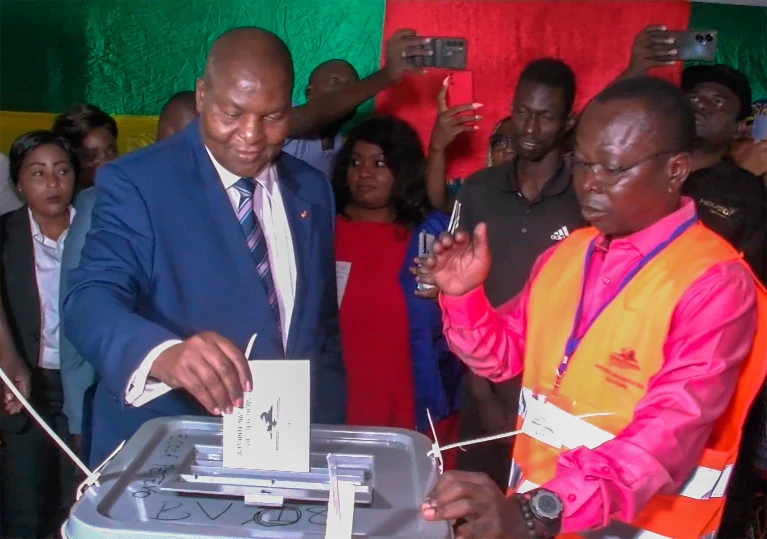
Central African Republic on Dec. 28 will hold presidential and legislative elections as concerns over armed groups have led to a growing reliance on Russia for security.
President Faustin Archange Touadera has led the country since 2016 and is seen as likely to win a third term after a constitutional referendum in 2023 removed term limits. His decision to run again sparked a street protest by thousands of people earlier this year.

Touadera is one of Russia’s closest allies in Africa, but tensions have grown this year over Moscow’s demand to replace the private Wagner mercenary group with the Russian military unit Africa Corps.
Meanwhile, rights groups have raised concerns about repression ahead of the vote’s first round, while a major opposition group vows to boycott it.
Here is what to know about Central African Republic.
Conflict with armed groups
The landlocked country of around 5.5 million people has been plagued by fighting between pro-government forces and armed groups.
In 2013, predominantly Muslim rebels seized power and forced the president from office. A 2019 peace deal was signed, but six of the 14 armed groups involved later withdrew.
Central African Republic’s government has signed peace agreements with armed groups in recent months that have created conditions for stability not seen in years, according to Human Rights Watch.
“Because of the peace deals, United Nations peacekeeping efforts and security support from Wagner and from the Rwandans, the country is in a more secure place than it was during the last electoral cycle in 2020,” said Lewis Mudge, the rights group’s Central Africa director.
The peacekeeping mission, MINUSCA, has been present since 2014. It currently has around 14,000 military personnel and 3,000 police members, and they will help guard election sites.
Last month, the U.N. Security Council extended the force’s mission for a year but said its presence would scale down due to budget constraints. MINUSCA spokesperson Florence Marchal told The Associated Press it was unclear how many peacekeepers will leave before the election but asserted that the reduction will not compromise its security.