

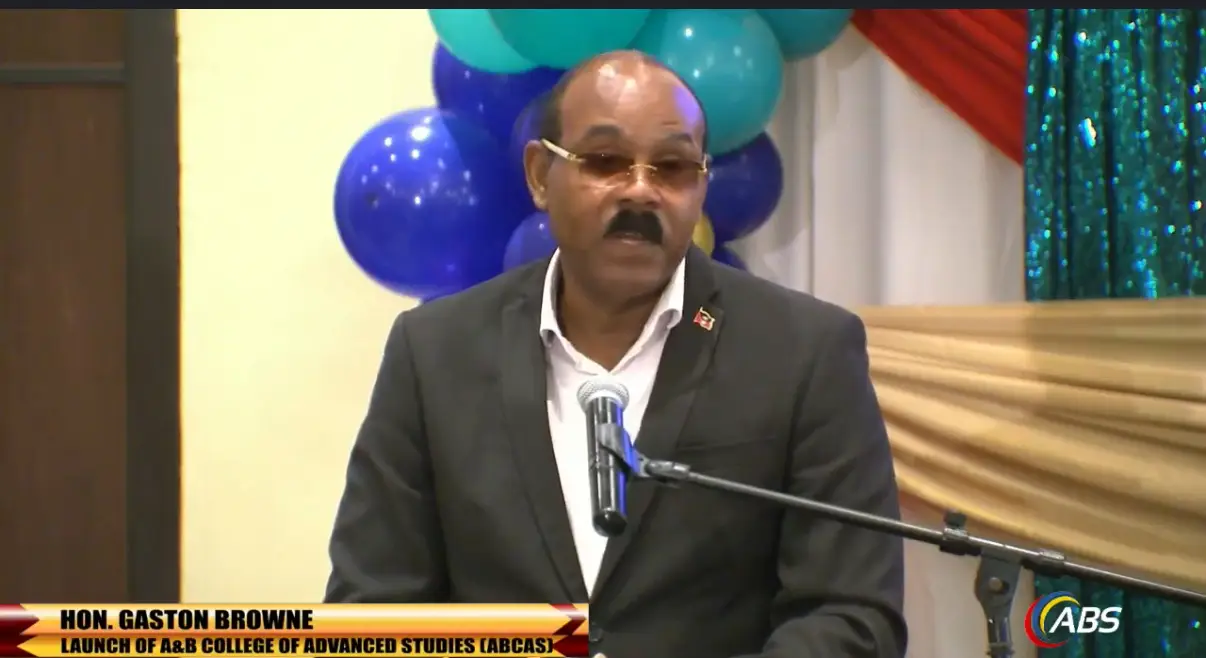
Prime Minister Gaston Browne has set out a bold education goal, pledging that within a decade at least half of Antigua and Barbuda’s population will hold a college or university degree.
He made the announcement at the launch of the Antigua and Barbuda College of Advanced Studies (ABCAS), calling the merger of the country’s tertiary institutions an “educational revolution” designed to anchor future national progress.
‘Achievable but ambitious’

Mr Browne acknowledged the scale of the challenge but insisted the target was within reach. “Within the next ten years, at least 50% of the population should have at least a college or university degree,” he said.
The Prime Minister linked the plan to his administration’s strategy of fostering inclusion and competitiveness through education, pointing to new opportunities created by ABCAS, the University of the West Indies Five Islands Campus, and overseas scholarship schemes.
Education, Mr Browne argued, is central to transforming Antigua and Barbuda into what he described as an “economic powerhouse” of the Caribbean. He said the government was determined to eliminate illiteracy and lack of skills, investing heavily in both traditional learning and second-chance programmes for those who did not complete secondary school.
“We must confine illiteracy and lack of skills to the dustbin of history,” he told the audience. “Every Antiguan and Barbudan must have some form of skill or educational attainment in order to make a meaningful contribution to nation building”.
The pledge could put pressure on local institutions to expand courses, staff, and facilities. It also raises questions about how the labour market can absorb a surge of graduates.
Mr Browne addressed the concern directly, suggesting that if jobs were insufficient at home, the country would “export skills” rather than risk underemployment. He argued that a surplus of qualified workers was preferable to a shortage.
The Prime Minister also urged the introduction of leadership and civics training at APCAS, saying education should instil discipline, national pride, and civic responsibility alongside academic achievement.
He tied the new institution to broader national goals, from cleaner communities to higher global rankings. Antigua and Barbuda already holds the Caribbean’s highest place on the United Nations Human Development Index, and Mr Browne predicted it would reach the global top 40 within three years.