

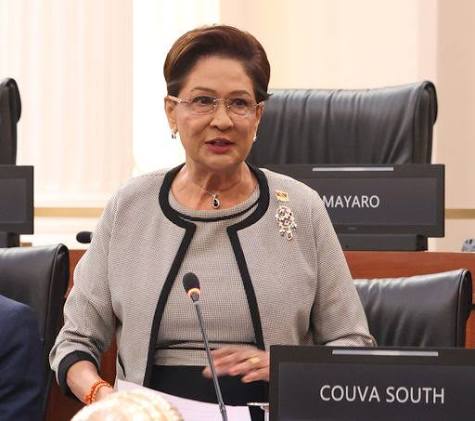
Prime Minister Kamla Persad-Bissessar’s special Independence Day message to United National Congress (UNC) supporters is drawing criticism from prominent voices within the Indo-Trinidadian and Hindu communities, with former Independent Senator Sunity Maharaj and Sanatan Dharma Maha Sabha (SDMS) Secretary General Vijay Maharaj warning that her rhetoric risks deepening racial divisions.
Sunity Maharaj, a political commentator, went further, saying many Indo-Trinidadians were embarrassed by the message and did not identify with what she described as its “mean-spiritedness” and divisiveness.

Speaking on Tuesday Talk with David Abdulah, Maharaj said the Prime Minister’s message was historically inaccurate and contained coded references aimed at Indo-Trinidadians.
“Very many Indo-Trinidadians do not share that view. They are embarrassed. They want the best of themselves to be reflected in the national tapestry,” Maharaj said.
“They do not want the mean-spiritedness that is reflected in that, the divisiveness.”
Persad-Bissessar issued the separate message to what she described as her “UNC family” as Trinidad and Tobago celebrated its 64th anniversary of Independence on Monday.
In the message, she reflected on the hardships endured by previous generations, referring to ancestors who worked in “lagoons, cane fields and oilfields,” survived on “salt and rice” and struggled for access to education and basic government services.
Sunity Maharaj argued that references such as “salt and rice” and “lagoons” amounted to coded language directed largely at Indo-Trinidadians.
“Where is the United National Congress? Where is the national part of the UNC if you are speaking to your membership and only referring [in] your coded languages about Indo-Trinidadians?” she asked.
She also rejected the argument that Persad-Bissessar was speaking to her political supporters and not addressing the country in her capacity as Prime Minister.
“A Prime Minister does not speak two different languages,” Maharaj said.
At her inauguration in May 2025, Persad-Bissessar pledged to be a Prime Minister for all citizens, regardless of political affiliation.
“If you are UNC, TPP, PNM or any other affiliation, I see you. You will be treated equally and fairly. I made a promise that everybody will win, and I plan to fulfil that promise,” Persad-Bissessar said at the time.
Sunity Maharaj described the Independence message as “inaccurate” and “full of dog whistles”, arguing that those defending it were attempting to “defend the indefensible”.
“You cannot be so unaware of history to write that nonsense, except that you have an agenda and the agenda is one of division,” she said. “We just have to call it for what it is. It’s just vile. It hurts.”
She also suggested the controversy could be serving as a political distraction from other important national issues, comparing it to a magician directing an audience’s attention to one hand while performing the trick with the other.
Separately, SDMS Secretary General Vijay Maharaj told Guardian Media he also believed the Prime Minister’s message had contributed to existing racial divisions.
“The country is already racially divided as it is. In my opinion, yes, this has just added to that division,” he said.
Maharaj, whose grandfather, Bhadase Sagan Maraj, founded the Democratic Labour Party (DLP), said he was reluctant to become deeply involved in racially charged political discussions because of his own historical connection to politics.
However, he said he believed Persad-Bissessar’s appeal could be interpreted as an attempt to consolidate the UNC’s traditional East Indian support.
“The appeal was, and it was to solidify the East Indian vote within the UNC, in my opinion,” he said.
Maharaj warned that the approach could also alienate people from other communities who supported the UNC in the last general election and potentially drive them back towards their traditional political bases.
Asked whether he believed it was appropriate for a political leader to appeal to one racial group, Maharaj responded: “I don’t think so.”
“I don’t think it’s appropriate at any point in time to appeal to one racial group, to be quite honest,” he said.
The SDMS Secretary General said he was particularly concerned about the timing, as the Hindu community enters an intensive period of religious observances, during which temples, schools and Hindu organisations will have an increased public presence.
He questioned whether those activities could now be misinterpreted by some as being connected to the Prime Minister’s political message.
Maharaj stressed, however, that he had not observed widespread racial favouritism by the Persad-Bissessar administration since it assumed office.
“I don’t think there’s much favouritism being shown to any racial group at this point in time. It’s just the calls and the words that have been spoken are indicating that,” he said.
“I have not seen it manifest itself outside there in the community.”
He did, however, point to the composition of several State boards, saying he had observed “a tremendous amount of East Indians” among directors and questioning whether this could be perceived as favouritism.
Maharaj also suggested East Indian businesspeople may now have to tread carefully about how their actions are perceived in the current political environment, although he was reluctant to elaborate, saying he was trying to remain neutral.
“We’re trying to be very tepid in how we converse and so forth. But the calls that have been made are not appropriate at this point in time,” he said.
“We are a nation that is undergoing tremendous change. Tremendous change in all different formats.”