

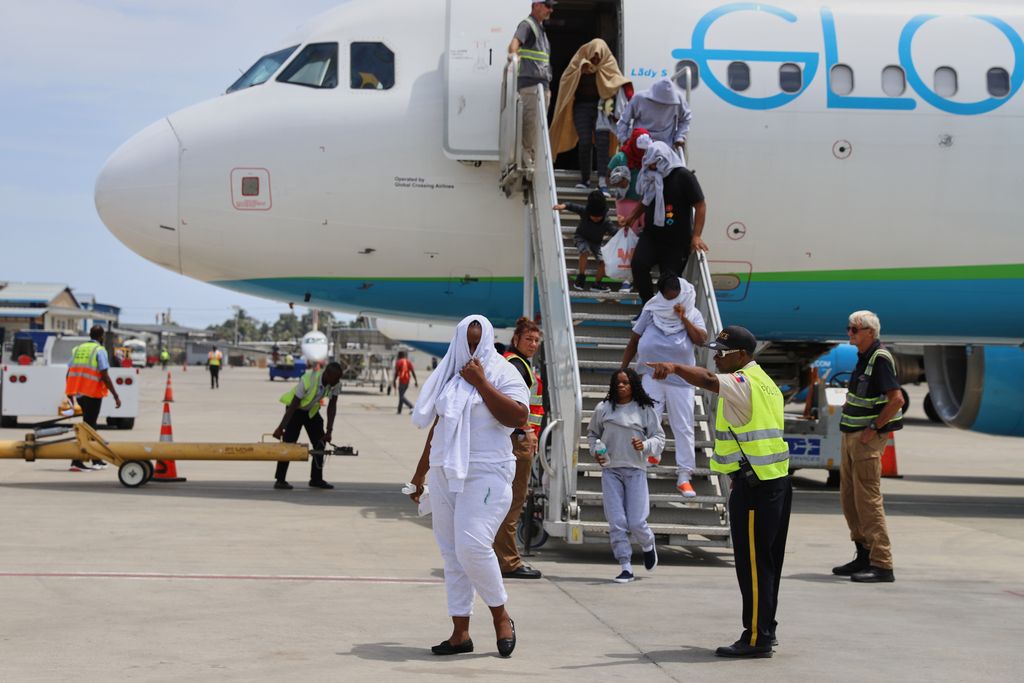
Several children, including a one-year-old child born in the United States, were among the latest batch of Haitians deported from the United States on Thursday to the French-speaking Caribbean Community (CARICOM) country.
Haitian authorities confirmed that the child arrived there on the ICE Air Global X charter flight A6196, carrying 57 Haitians, including several other children born in the United States when the second flight in a week landed in Cap-Haitien.

Deportation flights to Haiti had been occurring on average once a month, but the Trump administration has ramped up its programme following the US Supreme Court’s decision authorising the government to end Haiti’s Temporary Protected Status (TPS).
More than 300,000 Haitians were enrolled in this humanitarian programme, which allowed them to live and work legally in the United States due to the situation in their country. Haitian immigrant rights organizations and other stakeholders argue that Haiti remains far too dangerous for mass returns, while the DHS maintains that the situation has improved sufficiently to allow Haitians to return.
Of Haiti’s nearly 12 million inhabitants, more than half are in need of humanitarian assistance due to escalating gang violence and worsening poverty. Furthermore, nearly 1.5 million people have been displaced by gangs, as many as during the 2010 earthquake, which prompted the Obama administration to grant the TPS.
Earlier this week, the United Nations Integrated Office in Haiti, known by its French acronym, BINUH, said at least 1,408 people were killed and 656 injured from April through June this year. It said this was about 14 per cent fewer casualties than during the first three months of the year, a modest decline masking starkly different realities across the country. By May, nearly 1.47 million people were internally displaced across Haiti, more than half of them children
Meanwhile, the Archbishop of Miami, Thomas Wenski is urging President Donald Trump to reconsider his decision to deport the Haitians, saying last Sunday’s massacre in Kenskoff, overlooking the capital Port au Prince, that left at least 47 dead, including 22 inside a church, underscores the security situation in the country.
“This shows that the country is not safe, that Haiti is still a house on fire. This should cause our administration to rethink its decision to send back into Haiti over 300,000 Haitians,” he said, urging a rethink of the TPS revocation.
He said that Haitians are being returned to a country where crime, kidnapping, terrorism, and limited access to healthcare had become the norm.
“Haiti is a tragedy, and what we’re doing is compounding it by trying to send these people back,” he said, adding “even if you send a couple of planes a week, it’ll take several years before you are successful in deporting all those people.
“And what happens in the meantime is that they’ve lost their work permits, and they’ve lost their driver’s licenses for the most part. So, if they can’t work, they can’t pay their rent, they can’t buy food. Relatives in Haiti who depend upon remittances … will also be deprived of critical funds needed to educate children in the Caribbean nation,” he added. —PORT AU PRINCE, Haiti (CMC)