

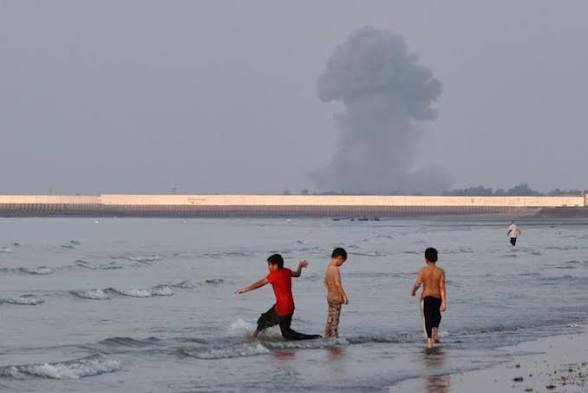
Drones carrying explosives targeted a city in northern Iraq where U.S. forces are stationed, and sirens rang out in Bahrain on Friday, hours after the American military said it finished its 13th night of strikes against Iran.
The conflict has flared again over the past week, as the U.S. pounded Iran while Tehran attacked ships in the Strait of Hormuz and targeted U.S. assets and allies in the region.

The strait, which is a crucial passage for the world’s energy supplies, is at the center of the latest fighting since Iranian attacks can effectively shut the waterway, sending fuel prices soaring worldwide and causing widespread economic turmoil. The Iranian-allied Houthi rebels added further pressure this week by targeting two Saudi tankers in the Red Sea, making good on a threat to cut off an alternative route for the region’s oil.
Despite the war’s unpopularity — and its widespread damage to Iran and the global economy — the latest round of fighting has no clear off-ramp. Iran’s Health Ministry said 55 people have been killed and over 600 wounded in strikes in recent weeks.
The U.S. and Israel attacked Iran on Feb. 28 and have offered shifting goals for the war, including toppling Tehran’s government and eliminating its nuclear program. But the conflict has devolved into a fight for control of the strait — with Iran apparently hoping to win concessions by inflicting damage on the global economy and the U.S. trying to limit that damage.
US strikes sites across Iran and countries in the region are targeted
U.S.-led forces intercepted and shot down five explosive-laden drones Friday over Irbil, according to security officials in northern Iraq. No injuries or damage were reported.
An Associated Press journalist heard at least seven blasts in the city, the capital of Iraq’s semiautonomous Kurdish region, and saw at least four plumes of black smoke rising from areas near or inside a base at the city’s airport that hosts U.S. forces. Flights continued as normal at the airport, the state-run Iraqi News Agency reported, citing the facility’s director. U.S. military officials in Iraq did not respond to a request for comment.
In recent years, the U.S. maintained about 2,500 troops in Iraq for training and to conduct operations against the Islamic State group with Iraq’s military. Many of those have withdrawn, but a small contingent of military advisers and others remains — many of whom have moved to Irbil.
Iran’s Revolutionary Guard urged people in neighboring countries to stay away from bases with American troops. The Guard said it had targeted the U.S. base in Udairi, Kuwait, setting ablaze three ammunition and storage sheds and destroying them. It also claimed to have struck a watchtower for the U.S. Navy’s Fifth Fleet, based in Bahrain, which it said was damaged.
U.S. Central Command did not respond to inquiries about the claims. Bahrain said it intercepted and shot down Iranian aerial attacks on Friday, but did not say if there were any casualties or damage.
U.S. strikes hit a Revolutionary Guard naval base in northern Iran, the semiofficial news outlets Fars and ISNA reported. Blasts from U.S. bombardment overnight were also reported on Iran’s Qeshm Island, a base for naval assets including drone boats that Iran can use to attack vessels in the Strait of Hormuz, as well as in Isfahan province, home to a major Iranian air base and one of Iran’s nuclear sites.
More strikes reportedly hit Iran’s southwest Khuzestan province and southern Fars province.
Central Command said the latest barrage was designed to “further degrade Iran’s ability to threaten civilian mariners and commercial vessels transiting regional waters” as the Americans push to regain control over the strait, through which one-fifth of the world’s oil and gas transited in peacetime.
Houthis open a new front in the war
Iran’s ability to effectively close the strait — and thus cause economic chaos far beyond the Middle East — gives it tremendous leverage in any negotiations. Its Houthi allies only increased that leverage when they targeted two Saudi oil tankers in the Red Sea on Thursday — increasing the risks of shipping through another vital route for Middle Eastern oil.
Brent crude, the international standard, topped $100 a barrel in the wake of the attacks, but dipped slightly on Friday to about $98. Gas prices in the U.S. ticked up to an average of $4.11 a gallon, AAA said.
The attacks made good on the Houthis’ threat to close the Bab el-Mandeb Strait to Saudi-linked shipping. The strait at the southern tip of the Arabian Peninsula connects the Red Sea to the Gulf of Aden, and around 12% of the world’s trade, including a fourth of global container traffic, passes through there.
That passage has become ever more crucial for Saudi Arabia, which has diverted millions of barrels of oil a day to its Red Sea port of Yanbu as a way of bypassing the Strait of Hormuz.
Houthis impose maritime blockade on Saudi Arabia
The Iran-backed group pledged to close the Bab el-Mandeb strait to Saudi-linked ships