

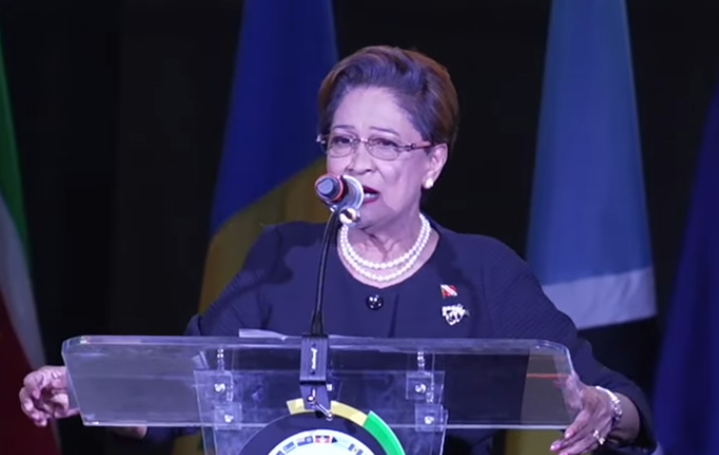
At the 50th meeting of CARICOM, The Prime Minister of Trinidad and Tobago, Kamla Persad-Bissessar, delivered a wide-ranging speech that balanced regional commitment with sharp critiques of CARICOM’s internal management and the geopolitical threats facing her nation.
She opened by celebrating the presence of other female leaders, such as the newly inaugurated first female president of Suriname, and shared her own deep personal ties to the region, having lived and studied in Jamaica and Barbados. She also marked a historical moment by introducing Chief Secretary Farley, the first representative from Tobago to attend a CARICOM meeting.

A significant portion of her address focused on issues of accountability and political interference.
She expressed deep concern over the October 2022 kidnapping of a Trinidadian citizen from another CARICOM state, an act she stated was ruled as such by the Supreme Court. She criticized the CARICOM Secretariat for failing to respond to her inquiries on the matter since 2022, suggesting this non-response reflected poor management or a lack of accountability.
Persad-Bissessar asserted that CARICOM must be a voice for all citizens, not just governing parties, and warned against the organization being misused for political protection and strongly condemned the practice of regional leaders or parties campaigning in the domestic elections of other member states, calling it a source of “unneeded factional divisions”.
Prime Minister Persad-Bissessar was vocal about the security threats originating from Venezuela, which she described as being led by a “narco dictator”.
She emphasized that while Trinidad and Tobago remains a partner in CARICOM, it must put its national interest first and defend its own sovereignty, especially regarding national security.
The Prime Minister explicitly thanked the United States (specifically mentioning President Trump and Secretary Marco Rubio) and the US military for their cooperation in combating narcotics and arms smuggling from Venezuela. She credited this partnership with a 42% decrease in murders in Trinidad and Tobago in 2025, representing 257 lives saved.
Regarding regional integration, she stated that while Trinidad and Tobago agrees in principle with full and free movement, it cannot implement it “at this time”. She cited the massive strain placed on taxpayers and health services by tens of thousands of illegal migrants, primarily from Venezuela, which is only seven miles away.
She challenged the region’s stance on Cuba, arguing it is an “oxymoron” to celebrate democratic elections in CARICOM while supporting a “dictatorial regime” in Cuba where citizens lack the same rights. She stated she would not support a dictatorship anywhere and advocated for democracy and capitalism.
Persad-Bissessar expressed support for the US and Panama’s proposed gang suppression force to restore order in Haiti.
She invited CARICOM nationals to utilize Trinidad and Tobago’s resources, specifically the new UWI South Campus set to open in September and the Couva Children’s Hospital, which she described as a state-of-the-art facility open to all citizens of the community.