

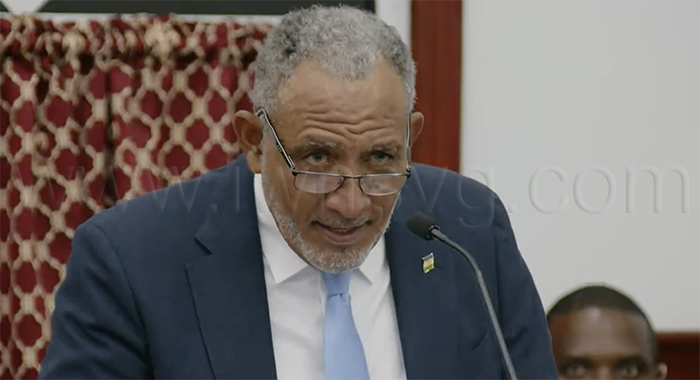
Parliament is slated to begin debating on Tuesday the EC$1.9 billion budget that Prime Minister and Minister of Finance Godwin Friday presented to lawmakers on Monday.
The fiscal package, the first by the New Democratic Party administration since it came to office on Nov. 27, contains no new taxes, as the prime minister said the government will focus on collecting existing taxes rather than raising rates.

Friday said that his government will improve the collection of existing taxes, including property taxes, and reducing concession granted by the Cabinet, which amounted to EC$624.1 million between 2022 and 2025.
Friday told lawmakers that the scale of import concessions granted between 2022 and 2025 has imposed a substantial and growing fiscal cost on the state.
He said the EC$624.1 million in forgone revenue amounted to 30% of the total value of concessional imports.
“In 2025 alone, the foregone revenues amounted to $152.3 million and equated to 64% of all revenue collected from taxes and charges on imports ($238.7 million),” the prime minister told Parliament.
“Put plainly, more than half of the revenue we should have collected at the border was given away through concessions. This level of revenue loss is no longer sustainable,” Friday said.
He said a 20% Reduction in total import concessions, applied uniformly across categories, would generate an estimated additional $30.4 million in government revenue each year.
“This figure is derived directly from the 2025 revenue loss and demonstrates that even a modest and disciplined rationalisation can create meaningful fiscal space.
Friday said this revenue gain can be achieved without abolishing concessions outright.
“Instead, it can be delivered through: Targeted priority sectors; tighter eligibility criteria; and stronger oversight, particularly where concessions are discretionary,” the prime minister told lawmakers.
He said special Cabinet concessions alone accounted for a significant share of the increase in concessions over the period 2022-2025.
“More disciplined management in this area would therefore deliver disproportionate fiscal benefits, without undermining productive investment.”
He said the estimated EC$30.4 million in additional annual revenue could be redeployed strategically, including to reduce the fiscal deficit and borrowing needs.
The money would also go to strengthen priority social spending in health, education, and social protection; or increase capital investment without raising tax rates.
“In the context of fiscal discipline and debt sustainability, a 20 per cent reduction in import concessions represents a high‑impact, low‑distortion policy option,” the prime minister said.
“It strengthens revenue mobilisation, restores fairness at the border, and preserves incentives that genuinely support productive investment and inclusive growth.”
Friday said that a central pillar of revenue reform over the medium term is the strengthening of the property tax system, which he said remains one of the most under‑performing and inequitable components of the tax framework.
He noted that the property tax regime was reformed in 2008 to adopt market value as the basis for assessment, replacing the outdated annual rental value methodology.
However, the current valuation list implemented in July 2013 remains in force, despite significant changes in market conditions over more than a decade.
The prime minister said that under the Valuation and Rating Act of 2012, the minister is empowered to order the preparation of a new valuation list.
He said the absence of a revaluation since 2013 has resulted in systematic undervaluation of properties, erosion of the real property tax base, inequities between taxpayers, and persistent revenue leakage.
“In addition, a substantial number of properties remain unregistered, further constraining collections and weakening compliance,” Friday said.
He said the government will therefore commence a nationwide property registration programme to expand coverage of the tax roll, and a comprehensive national property revaluation exercise.
“These reforms will broaden the tax base without increasing rates, enhance fairness, strengthen compliance, and generate sustainable revenue to support fiscal consolidation and local service delivery,” Friday said.
On the topic of tax and customs administration, the prime minister said revenue sustainability depends not only on tax policy, but on administrative capacity and enforcement discipline.
Friday said strengthening the effectiveness of the Inland Revenue Department and the Customs and Excise Department is central to this Government’s revenue strategy.
He told lawmakers that at the Inland Revenue Department, the full digitisation of tax administration is underway through the implementation of a modern Tax Information Management System (TIMS) under the Caribbean Digital Transformation Project. Once fully operational, by 2027, all major tax types will be integrated into a single digital platform.
In parallel, the Tax Administration Act will be fully enforced; audit capacity will be strengthened, including joint audits with Customs and Excise; and tax arrears collection, particularly for PAYE and VAT, will be intensified.
He said that at the Customs and Excise Department, the development of the Vincy Single Window for Trade Facilitation (VSWiFT) will integrate 16 trade‑related government agencies into a single digital interface.
“This reform will reduce clearance times and transaction costs for traders; improve risk management; strengthen revenue collection; and enhance transparency and compliance,” the prime minister said.
He said an updated Customs (Management) Act will also be enacted to strengthen post‑clearance audits, advance rulings, and penalty provisions.
“Together, these reforms treat administrative efficiency as a form of revenue enhancement, not through higher rates, but through better governance,” Friday said.
Opposition Leader Ralph Gonsalves is slated to lead of the Budget Debate on Tuesday at 9 a.m.