

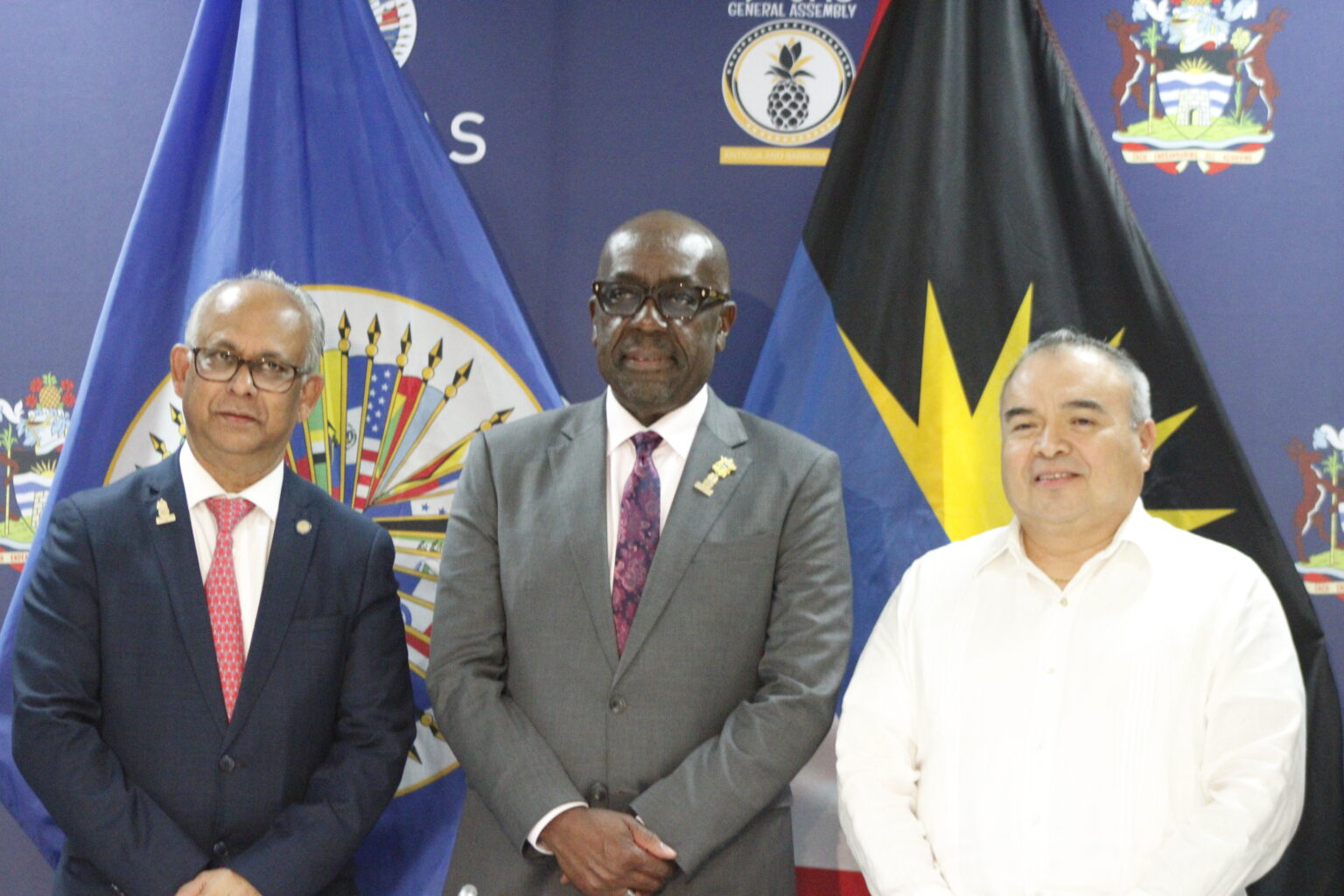
Secretary General of the Organisation of American States (OAS) Ambassador Albert Ramdin unveiled his multi-pronged approach to addressing his organisation’s chronic financial crisis during Friday night’s closing press conference, while praising Antigua and Barbuda’s “excellent” hosting of what he called a transformative General Assembly.
Speaking at the conclusion of the 55th OAS General Assembly, Ambassador Ramdin acknowledged the stark reality facing the hemispheric organisation: operating with “barely $90 million when at least $120 million is required” for effective functioning, as host nation Antigua and Barbuda via its OAS representative Sir Ronald Sanders had pointedly noted during the multi-day meeting.

This sentiment was echoed by several OAS member states, including Costa Rica, which called for “channelling scarce resources toward shared priorities rather than dispersing efforts”, and Dominica, which emphasised the need to address “structural financial challenges” while strengthening the development pillar to match attention given to democracy, human rights, and security programming.
During the proceeding, The United States called out the organisation for the ineffectiveness in addressing regional challenges, suggesting US reduction in financing the organisation if changes are not made.


During the press conference, Ambassador Ramdin outlined his plan to bridge the $30 million funding gap, emphasising that simply asking member states for more money would be premature without first demonstrating the organisation’s value.
“We are going to do a couple of things before that,” he explained to reporters. “First of all, [we need to] showcase the OAS, tell the story from the OAS, what we are doing so that the value of the OAS is known.”
The reform strategy includes four key pillars: demonstrating organisational value through concrete results, expanding specific funding through donations and grants from member states and permanent observers, engaging the private sector as stakeholders rather than philanthropists, and improving internal efficiencies while streamlining mandates.
Ambassador Ramdin noted that member states often receive “five to ten times more out of the OAS than they contribute”, citing electoral assistance missions that cost approximately $250,000 – already exceeding some countries’ total annual contributions.
During the General Assembly, Sir Ronald Sanders proposed three concrete reforms: adopting a realistic budget, implementing penalties for quota non-payment, and basing calculations on 32 active members rather than 34, acknowledging that Cuba and Venezuela are no longer participating.
“This is the only organisation in the world where you cannot pay and yet command every senior position,” Sir Ronald said, calling the current arrangement politically untenable.


When pressed about conversations with member states regarding these specific reforms, Ambassador Ramdin emphasised the organisation’s cost-effectiveness, noting it operates with approximately 450 staff members and 400 consultants – making it “a pretty low budget organisation” compared to other regional bodies.
The Secretary General announced plans to modernise operations through technology, including artificial intelligence for document production and meeting minutes, and to pursue multi-year programming rather than project-based funding.
Foreign Minister EP Chet Greene, reflecting on hosting the Assembly, said Antigua and Barbuda’s measured success would not be in “dollars and cents” but in contributing to hemispheric peace and democracy.
“We look at this in terms of what it does in relation to our contribution to the development of peace, democracy, and justice in the Americas,” Minister Greene told reporters. “That is our first focus.”
The minister, however, did acknowledge that the over 2,000 delegates brought “added value to our economy” and increased global recognition for Antigua and Barbuda, but stressed the overriding satisfaction came from the nation’s role in addressing regional challenges.
The Assembly addressed multiple critical issues, including mental health – a resolution tabled by Antigua and Barbuda – and the ongoing crisis in Haiti, for which Ambassador Ramdin announced a comprehensive roadmap would be ready by mid-July.
Ambassador Ramdin praised the host nation’s organisation throughout the three-day gathering, noting that “everything went perfectly well” despite the complexity of the event and the risk of hosting during the Atlantic hurricane season.
“The organisation of this conference was excellent. And I hope that we will continue to see that happening,” the Secretary General said.
As the hemisphere prepares for the next General Assembly in Panama, Ambassador Ramdin expressed optimism that the reforms initiated in Antigua and Barbuda would demonstrate the OAS’ continued relevance and effectiveness to skeptics of multilateralism.
“By next year in Panama City, we don’t want a discussion about the usefulness of multilateralism anymore,” he declared.
The Organization of American States is the world’s oldest regional organisation which works with Caribbean nations to strengthen democracy, promote sustainable development, and enhance security cooperation.
Much of the work of the organisation revolves technical assistance to the Caribbean region, including monitoring and providing support to strengthen elections, boosting expertise in cybersecurity, drug policy.